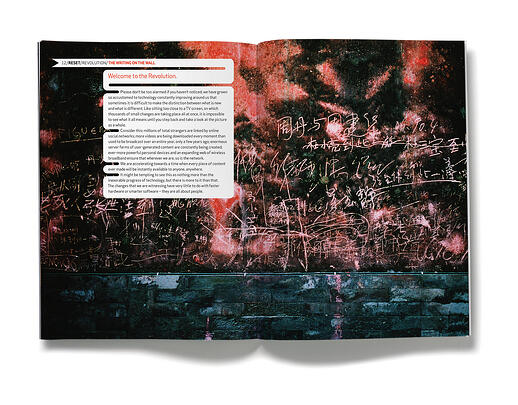
The first question my publisher asked me was why a book and not a blog? Three years ago when I started working on Futuretainment, that was already a tough question to answer. With eBooks now on the crest of critical mass, it hasn't got any easier. Last week, my book hit the shelves. Although you can buy it on Amazon, you can't read it on a Kindle. In fact, with 300 pages of illustrations, original photographs and custom designed typography - it is about as Kindle friendly as a bathtub. That was a deliberate decision on my part, but it comes at a time when the very concept of a book is changing.
This Christmas, a very large number of people will recieve their first eReader. I have no doubts it will kickstart a transformation of the publishing industry. It happened with DVD players, digital cameras and MP3 players. Now, it is going to happen to books. Amazon have finally released a global edition of their Kindle which allows wireless book delivery in over 100 countries. Sony has been busy too - introducing a sexy eReader integrated with Google's book platform, while Apple's long awaited messiah tablet is mere months away. If nothing else, there will soon be a generation of school children who get to grow up without being disabled by weightlifting a satchel of text books to class every day.
None of this spells the end of books and book writing. Quite the contrary. There are two aspects to any book. First, there is the book as an informational construct. Put simply - an arrangement of words, sentences, paragraphs and chapters. However in our attention drained world of 140 characters, this construct increasingly boils down to a simple image - the long tail, the tipping point or the black swan. Despite fervent claims to the contrary, the vast majority of people don't actually read books. They consume metaphors and debate in status updates.
Fortunately, there is also a second aspect of books - 'thingness'. Whether a Sumerian stone tablet, an Egyptian papyrus, an illuminated Medieval manuscript or just a pulp paperback - there is a physical side of books which has its own life. Here is where eReaders will attack. Dead trees are an inefficient form of information transmission. From now on, to survive as an object, books will need to serve a greater function than communication. In times past, the wealthy lined their houses with leather bound rare editions. Expedient booksellers would literally sell knowledge by the metre. After all, a library of physical books was part of the symbology of money and power. We may soon come full circle.
For all of these reasons, I embarked on the journey of trying to create my own book. While writing a blog can give you influence and notoriety, a book has a sense of completeness which a series of online posts can never achieve. Moreover to write about the digital revolution required some distance from the immediacy of online chatter in order to make sense. I knew from both my days at Jupiter Research, and also working for the Murdochs at Newscorp that the Internet was changing every aspect of how lived. But as much as I liked gadgets, the revolution was not being led by computer innovation. In fact, the most profound changes were taking place because consumers were changing the way they behaved. That meant thinking less like a technologist, and more like an anthropologist.
I had encounted the first glimpses of these disruptive forces while advising media companies in Asia - savvy and socially networked teenagers in China, Japan and Korea armed with advanced mobile phones, fast wireless broadband, multiple virtual avatars and a cavalier approach to copyright - they were the forerunners of entirely new type of consumer. As tough as it was for traditional businesses to understand - anyone born after the introduction of the first web browser in 1994 was quite simply unlike any generation before it. They had never known a world without the Web, and so never knew a world where they couldn't get any piece of content, on any device, at any time. And importantly, with a hat tip to the Mayan's for predicting a civilisation changing event taking place in the next few years - in 2012 that generation would all turn 18.
Of course, if I had known just how hard it would be to create a visual book - I might have indeed stuck to blogging. But as they say, there is a certain boldness in naiveté. With a first draft of my manuscript, I approached the iconic designer Vince Frost. Vince had recently opened a studio in Australia, after a successful career in the UK where he had been one of the youngest ever directors at the legendary design powerhouse Pentagram. One of the first aesthetic challenges we hit when planning the book was creating a future forward look that wouldn't date.
The solution lay in the past. The design of the fifties and sixties had a clean, directional look that was at once futuristic and yet, being nearly a half century old, dislocated from contemporary views of tomorrow. Some of our sources of inspiration included the little known Swiss designer Hans Hartmann, Giovanni Pintori's designs for Olivetti, the Latvian literary magazine Jauna Gaita, and the iconography of the 1968 Mexico Olympics. Vince and his team did an incredible job on the visual look of the project, right down to the imposing f cut out of book's front cover and a website which integrated social media in mesmerising melange of animation and video. As the project went forward, we used the Web to colloborate. I scanned and uploaded photos taken with my old school Leica M6 on 35mm film, and on the other side of the world, Vince's designers accessed the high resolution photos from Flickr.
I ran into an old friend of mine recently who told me that as an author the best possible moment is when you see your first book in your favourite book store. I smiled, and asked him whether that was really better than, as he has, seeing a royalty check for your ten millionth book sold. He just winked.
In ten years we will still have books, but they will serve a different purpose to what they do today. The Japanese may well invent an eReader which emits the faint smell of paper to soothe those who yearn for the tactile romance of print. Because, as much as I love my Kindle, it is a marriage of convenience. My true mistress will always be books. The smell of print, and the sensual touch of high quality paper will never fail to seduce me. And I can only hope that my book might elicit the same response in you.