Mike Walsh

Recent Posts

Be Sweet, Please Retweet

Posted by Mike Walsh ON 10/7/09, 11:13 PM

retweet


There has always been something alluring about the myth of the creative advertising genius. A Mad Man style maven sitting in a palatial corner office, twirling a pencil and then devising a diabolical way to sell more cigarettes, cars or potato chips. But the new media landscape has made a mockery of that. It used to be enough to make ads that people remembered when they watched them. Now, being a great creative means being smart enough to ensure people watch them at all.

Early this year, I spoke at PromaxBDA Europe - a TV marketing conference in the Czech Republic. Prague is a beautiful city. Look outside your window and you will be rewarded with an exquisite gothic skyline marred only by a single building — the Žižkov TV tower. When I asked about it, I was told that the Soviets thought that if they beamed out a strong enough TV signal, they could blanket out any competing programming from Western countries. It was a cunning plan and quite possible in a world where television had a monopoly on moving pictures and sound in households. For the last 50 years or so, you could literally buy people’s attention. Now, it’s not so easy.

On the Internet, there is no concept of prime time. You can program television, but when online people discover and consume content, it is often because it has been sent to them by other people they know. Whether a tweet on Twitter, a blog post on Wordpress or a shared link on Facebook, the most influential distribution assets now are not broadcast networks but rather audience networks.

Consider the recent transformation of the social media space. Social networks have evolved from an orgy of self-expression to brand communication channels and tools of political influence. The new prize is realtime search. Traditional search is great for finding non-time-sensitive material, but if you want to know what people are saying and thinking right now about your brand, TV show or anything else, you need to be able to dip into the live stream of social chatter and link sharing.

From a creative perspective, real-time search creates a unique challenge. Stunning art direction is useless if no one actually watches your ad. In a world of audience networks, people will only forward your content to their friends and followers if it makes them look smarter or cooler by doing so. Their brand, not yours is at stake. You would be surprised how few marketers take that into account and are left wondering when their viral campaigns are socially vaccinated before they get off the ground.

Funnily enough, one of the best examples of smart social creativity this year came from far North Australia. Tourism Queensland’s “Best Job in the World” campaign took three Grand Prix awards at the Cannes advertising awards this year. The campaign, which was ostensibly just promoting a caretaker job on Hamilton Island, generated more than AU$332 million in media coverage, 34,684 video entries from 197 countries and eight million site visits with an average of eight minutes and 15 seconds spent on the site per visitor. What made the campaign so effectively viral was not how it looked or where the ads were placed, but rather the power of its core idea. After all, who wouldn’t want to get paid to hang out on a desert island? Great ideas are like social candy to consumer networks.

Social media doesn’t mean the death of TV advertising, but it does place it into context. Broadcast is a powerful medium for rapidly raising awareness, but the reality of media fragmentation means that to get real engagement requires your customers to do the distribution for you. And that, quite frankly, is not easy. The trick of turning audiences into advocates requires more than just savvy media planning or bribing people with free iPods.

It takes true creative genius.


- - - - - - - - - - - - - - - - - -

What do you think? As always - I welcome your thoughts and feedback through the community forum. Click here to comment.


 

Read more

CATEGORY: Marketing

Running Late

Posted by Mike Walsh ON 8/17/09, 4:41 AM

describe the imageSometime ago, I lost my watch. I came home, and it simply wasn't on my wrist. Since then I learned one rather curious fact about time. Like switching off your mobile phone, not having a watch mainly causes inconvenience to other people. Time as it turns out, is not the domain of astrophysicists and Nobel laureates but rather a clunky construct of social co-ordination.

It's not hard to run late. Time is a more fluid concept that you might think. And I'm not talking about relativity. Before time became enslaved to an ensemble of atomic clocks around the world, it was tied to an official chronometer in Greenwich kept in synch to assist maritime navigation. This accounts for those references to GMT, or Greenwich Mean Time that turn up in those odd little meeting request messages dispatched by Outlook. Not that I paid much attention. Even when I owned a watch, I had little concept of a universal constant. Periodically when I turned up to get my hair cut, the clock in the salon was always five minutes fast. So naturally that meant I was always late and my hairdresser always yelled at me. I seriously considered synching my clocks to his one. His mean time was considerably meaner than that of Greenwich.

But my hairdresser had a point. Whatever the universal time might say, it is irrelevant unless the people meeting up have the same basis of measurement. Consider what happened during the French Revolution. On November 24, 1793, a decree of the Convention Nationale introduced a decimal division of time. After that point, if you were to ask a fellow revolutionary in Paris what the time was, they might have answered seventy five minutes past six. Naturally confusion abounded. Many watches created during that period had a double display of both classical and revolutionary time. Unfortunately like the Revolution itself, the temporal schizophrenia was also shortlived. After 18 months, clocks went back to normal. And the French found other things to be uniquely French about.

Francophiles were not the last to meddle with clockwork. Despite what you might think - the word Swatch was not originally intended as a contraction of Swiss (Made) Watch, but rather Second Watch - a fun, casual accessory to your main time keeping device. In the late nineties, right after the first Internet boom - the Swatch company decided to re-invigorate some of the spirit of the decimal revolution and introduce Swatch Internet Time or Beat Time. Beat Time divided the day into 1000 .beats with @000 being midnight and @500 being noon. Controversy abounded, not least because being very European about the whole thing - the Swiss chose Central European Time rather than Coordinated Universal Time as the basis of the system. But the bigger problem was, just like in the French Revolution, no one could be bothered to learn a new system just to hang out with each other more effectively.

In a way I wished they had. As someone who lives nomadically in the cracks between timezones - my calendars and conference calls are always in a state of constant confusion. It finally made me think - if time is the primary tool we rely on for organising our interactions with other members of society - how can we make clocks more social? Should a clock not be a social network, or a social network not be a clock? I pondered the thought as I watched the Japanese fashion brand Uniqlo's human clock and quirky calendar. With it's crazy Pachinko sound track, here was a clock that gave you a sense of the life behind the minutes and seconds that ruled us.

So what if your watch instead of just telling you it was 3pm, also informed you what your work colleagues had planned for the next few hours, or what your friends were planning on doing at 8pm when you all finished work. We all have a forward light cone of things that we might do. Sharing this information makes more sense from the perspective of social co-ordination, than simply adhering to a systema of standardised timekeeping. At the The Long Now Foundation, they are making plans to build a clock that will last 10,000 years. Like the monks in Neal Stephenson's Anathem - it is a clock designed to give us a deeper perspective of historical time extending far beyond our impressions of the immediate moment. I like the romance of the idea, but for me - a clock is only useful if it can give me a sense of possible futures not extended pasts.

Whoever said there was no time like the present was quite mistaken. There is no time in the present. Like a garden of forking paths, it would be nice to know what I could do with the next minute rather than simply be aware of it's passing. Rather than historical time, it would be social time. Time enough, you would hope, for me also to think about buying a new watch.


Read more

CATEGORY: Philosophy

Easter Eggs

Posted by Mike Walsh ON 8/2/09, 3:23 AM

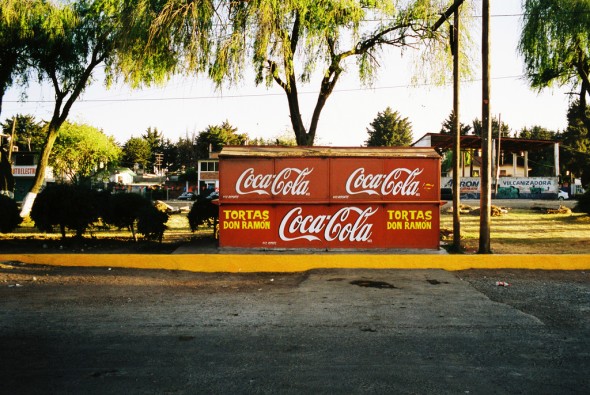
cocacola


After a month in LA, I honestly felt like I was starting to see things. American fast food suffers from an identical crisis. Burger joints, juice bars, coffee shops - it's an endless parade of franchise repetition. But after I complained one too many times, I was pulled aside and informed in a hushed tones that I had it all wrong. 'You just need to know about the secret menus', said my friend. And she was right. I did need to know. Because even the most boring of brands, it turns out, have a back door.

Sameness is an inevitable consequence of capitalism. You might start life running a ultra hip underground Korean Taco truck in West Hollywood that plays accoustic K-pop remixes of the Beach Boys - but fifty trucks later, you will quickly swap unique and cool, for mass and market. But as I discovered, whether by accident or design, certain franchise brands seem to have evolved a secret language of signs and symbols known only to the select consumerati.

Here are a few examples:

- In-N-Out Burger has a very simple official menu, but a wide variety of unofficial ordering phrases. Ordering your burger "Animal Style" will grant you secret sauce and grilled onions, a "Flying Dutchman" is a burger with no bread or lettuce while "Protein Style" is a burger wrapped in lettuce instead of a bun. You can also upsize yourself by asking for a 3x3 or 4x4 (multiplies the meat and cheese). And even more bizarrely, there are small codes on the wrappers of most items. Look closely at the paper surrounding your cheeseburger and you will find the numbers 3:20, which equate to a Bible passage in Revelations: "Behold, I stand at the door, and knock: if any man hears my voice, and open the door, I will come in to him, and will dine with him, and he with Me." God loves burgers too, it seems.

- Jamba Juice has an entire secret menu of unhealthy and rather inappropriately named smoothies including the 'Dirty Orgasm' and 'Hello Jesus'.

- Starbucks will serve you something called a 'Red Eye' which is a cup of coffee with a shot of expresso dumped in it. They also keep tiny cups under the counter which they don't advertise. Ask for a 'short' latte and you will discover the joys of more coffee, less milk. And for the real franchise fanatics, you can memorise the specific order of options used by Starbucks baristas when they yell at each other. Here's the options order: hot or iced, size, drink style, wet or dry, strength, milk style, and any final directions (extra hot, no foam, light ice).

Building secrets into brands reminds me of the art of hiding 'Easter Eggs' in games and movies. Programmers would often leave amusing pranks inside video games or software applications for those that knew how to find them. Early versions of Microsoft Office had hidden flight simulator and pinball games, and if you typed 'make love' into some Unix Operating Systems, the computer would reply 'not war?'. And according to legend, the original laser disc version of 'Who Framed Roger Rabbit?' not only had naked stills of Jessica Rabbit, but the then CEO Michael Eisner's home phone number scrawled on a Toontown restroom wall.

All of this may seem a bit odd, but I think that more brands should have 'Easter Eggs' hidden within them. They provide a lenticular quality. From one side - consumers will see the mass market product - which you need in order to present a simple and consistent message to the world. But look slightly askew, and your true evangelists will have access to their own private world of special products, ordering styles, personalisation and brand mythology. And having been initiated into your secret society, you can be sure that they will be more likely to spread the word and do your marketing for you.

Of course, like any game of Chinese Whispers, things can get a little lost in translation. Think of the unfortunate Filipino man in the queue in front of me, who confident in his new In-N-Out Burger Jedi ordering skills, demanded loudly that he would like a 'Double, double... doggy style'.

Read more

CATEGORY: Marketing

Obsolescence

Posted by Mike Walsh ON 6/10/09, 6:47 AM

There is drawer in my house that is a graveyard. Adapters, gadgets, phones, music players, digital cameras - all once proud icons of the state of the art, now just a kind of art of the static. I know a Japanese blogger who inscribes in marker pen the date he buys a new toy so that he knows for how long he has had it. That strikes me as macabre. I don't want to be reminded of the half life of contemporary treasure. But still, it raises an interesting question. Should we despair at obsolescence or rejoice in the cult of the new?

Obsolescence is an inevitable consequence of capitalism. Think long enough about the logic of mass production and you will start believing in the divine necessity of building things designed to be thrown away. If we become wealthy through work, and work is created through things being made - then making something too well reduces the necessity of its continual replacement. You might remember the satirical scenario in Huxley's 'Brave New World' where the citizens of a perversely happy Utopia vie to entertain themselves in games and activities that use the maximum amount of resources. There is no doubt that waste creates wealth, but what does it do for happiness?

Well, it's hard to say - for the simple reason that the reason we buy things now has little do with replacement and everything to do with desire. Few people buy a new product because their old one is broken. They buy because objects and their ownership offer passports to worlds of pure symbolic joy.

Take Apple for example. Have you ever heard of a company where people hang on press releases like the Second Coming, turn up to product briefings as though they are spiritual rallies and immediately seize upon the latest version of whatever perfectly good gadget they previously owned to embrace the new, new thing? And it's not just technology. In Hong Kong, there is an entire black market trade in last season's luxury goods. For those that must have the latest look handbag - the handbag itself is worthless - it's the newness that counts. Cantonese fashionistas and rich wives trade in their precious commodities often months after purchase - to be snapped up by the lower rungs of mainland factory girls with their eyes on the prize.

There is an empty satisfaction in all of this. Continuous acquisition creates a kind of personal momentum that one can easily mistake for meaning. But to be honest, looking at my technology graveyard - i only feel remorse. When I think about the things that really make me happy - my old mechanical cameras, my fountain pen, my leather worn diaries, my beat up old leather satchel - it is their longevity that I prize. At some point in my owning them, they seem to have lost whatever brand signal they once possessed. Now they just radiate my own personal signature. I love that. It's like they stopped becoming mine and started becoming me.

And as to my own personal obsolescence, well - I'll guess I'll just have to get back to you on that one.

Read more

CATEGORY: Philosophy

What's Next For Music?

Posted by Mike Walsh ON 6/8/09, 4:50 AM

musicThe funny thing about the music industry these days is the growing influence of people you would least expect to be hanging backstage with the band. Mobile operators, handset manufacturers, broadband providers and even social networking geeks - Music is fast becoming the digital currency de jour for anyone who wants to engage with consumers online. But what does that mean for the value of music going forward?

The future of music was a question hotly debated at this year's Music Matters conference - Asia's peak music industry summit held in Hong Kong. Value is a complex issue. If songs have intrinsic worth in themselves, then their commercial distribution should be defended to the hilt even in the wake of overwhelming piracy. If greater value lies elsewhere - for example selling concert tickets, branded merchandise or reducing churn on mobile data plans - then music should be free and leveraged as a promotional platform.

With fast broadband, advanced mobiles and media hungry consumers - Asia is a great laboratory for understanding where the entertainment industry is heading. In most cases, consumer behavior is still way ahead of corporate attempts at commercialisation - hence the lawsuits. But there are growing pockets of innovation. Here is a quick primer on four areas where consumers are pushing the boundaries of the traditional music industry:

- - - - - - - - - - - - - - - - - -

1. Buying Music From Your Phone

Until very recently, ringtones were a major cash cow for Telco operators. But as mobile networks have become faster and handsets smarter - mobile music products have also had to innovate. Japan's sophisticated mobile market is a case in point. According to the RIAJ, last year 90% of Japanese digital music sales took place on mobile phones, with only 10% over the Internet. The new music profit driver in Japan 'over the air' (OTA) song purchases. 'Chaku-uta', (30-second song snippets) and 'Chaku-uta Full' (MP3 full-length songs) have become very popular with consumers, and are largely distributed through a platform called Label Music, owned by all the major record labels.

Nevertheless, Japan is a curious and unique market. Contradictions abound. An aging population, which still prefers buying CDs, continues to support the sales of physical music. So local music labels have a segmented marketing strategy. They target the over forties with CDs and albums, and kids with mobile distribution and digital singles. The latter has had an interesting impact on the creative process. Take superband GReeeeN for example, which are focused primarily on the mobile and download markets. Unlike typical Japanese Tarento, the band refuses to show their faces - the cute story being that they haven't told their parents yet. Their hit song "Kiseki" recently broke all the records with 2.3 million chaku-uta full downloads.

Japanese mobile success may be hard to replicate elsewhere. While Asian kids have adopted their phones as music devices - sideloading poses a longer term challenge to the OTA business model. According to Synovate, across Asia 46% of young users download music and transfer tracks to their phone. Only 21% regionally download music directly to their phone.

2. Finding Music on Search Engines

The second area where the music industry is being forced to keep pace with consumer innovation is around search. In China, digital piracy is rampant. The vast majority of music is illegal - and even if you do buy a physical CD - chances are, the retailer selling it to you stole it himself. Not surprisingly, MP3s are one of the most popular search items on the major search engines in China. The China Market Research Group estimate that music accounts for 20 to 30 percent of all searches on Baidu. To combat Baidu, Google China launched its first music platform - Google Music, which in partnership with Top100.cn offers free advertising supported music search and streaming. All the music on the site has been legally provided through deals with the major labels - the vast majority of which had long since given up making money from anything other than ringtones in China anyway.

What makes Google Music interesting, however, is not just free legal music. One of the key enteratinment issues in China is discovery. An unusual consequences of the growth in ringtones in China has been the proliferation of what literally translates as 'saliva music' - songs that are simple in melody, and designed for the limitations of a 2G ringtone. Unfortunately, that makes the long tail in China pretty short.

To help expose Chinese users to a greater depth of artists and music tracks - Google Music uses an algorithym that analyses the timbre, rhythym and beat of songs, in order to recommend similar tracks. The results are impressive but like elsewhere in the world - the jury is still out as to whether revenue sharing on free streamed and downloadable music tracks will be worthwhile for content owners. But at least now, unlike before - the labels in China have skin in the game.

3. Mixing Music with Friends

The third trend in music innovation is around social media. Forget Myspace Music - if you want to see the future of commercialising music through social networks, take a look at Tencent. Tencent operates the instant messaging community QQ. It has over 200 millions users in China, and even more impressive - over a billion (USD) in revenues. Unlike social networks in the US like Facebook or Myspace - online advertising last year contributed only $120.9 million to Tencent's revenues. The vast majority of the top line revenue figure ($719.1m) came from interactive services like virtual items, personalisation and music.

In exchange for small transaction fees, Tencent allows users to play music in the backgrounds of their profile pages or dedicate music to each other. It has been estimated that they make between $30-40 million a year alone on these music based services.

Virtual merchandise and the commercial integration of music into social platforms is a lesson that the West could well learn from countries like China and Korea. While platforms like Myspace Music, Last.FM and iMeem do a great job at supporting music discovery - their advertising dependent business models are still only half formed.

4. Bundling Music with Everyone Else

Finally, it is worth thinking about the potential impact of offering consumers access to large music libraries as part of bundled subscription services. Telco operators have started to pay attention to music for two reasons - ARPU and churn. But do consumers care? Denmark is an interesting case study. Under Danish law, Telcos can only bind their customers to six month contracts - making renewals a serious issue. TDC, Denmark's major carrier launched a service in March 2008 which gives their mobile and broadband customers unlimited access to music downloads for free. Of course, if you cancel your subscription, you also lose access to the music. So far, their plan seems to be working - churn is down 60%. But as a consumer model, it is still less than ideal.

Danish telcos are not the only ones looking to use music to bind consumers more tightly to their services. Even handset manufacturers like Nokia are offering unlimited music downloads to consumers who buy certain models of their phones. Music subscription services are a double edged sword for consumers. They offer infinite choice, but often lack the community infrastructure to aid music discovery. Further, the looming threat of cancelled access provides little incentive for consumers to invest time in curating a collection.

- - - - - - - - - - - - - - - - - -

Taken together, all of these four trends are examples of businesses adjusting to the new ways that audiences are consuming digital music. The longer term structure of the music industry is still far from certain. Things are moving fast, and the worst possible mistake is to focus on fading metrics. The top line retail sales look bad, but they only tell part of the story. At the current rate of change, in five years time - measuring the quarterly drop in CD sales may be about as useful as tracking the current decline of cassette tapes. It's time to start watching the new sources of growth and leave dying formats in the grave.

After all, the first thing you need when the world changes is a new set of maps.

- - - - - - - - - - - - - - - - - -

What do you think? As always - I welcome your thoughts and feedback through the community forum. Click here to comment.

Read more

CATEGORY: Media

New call-to-action

Latest Ideas