
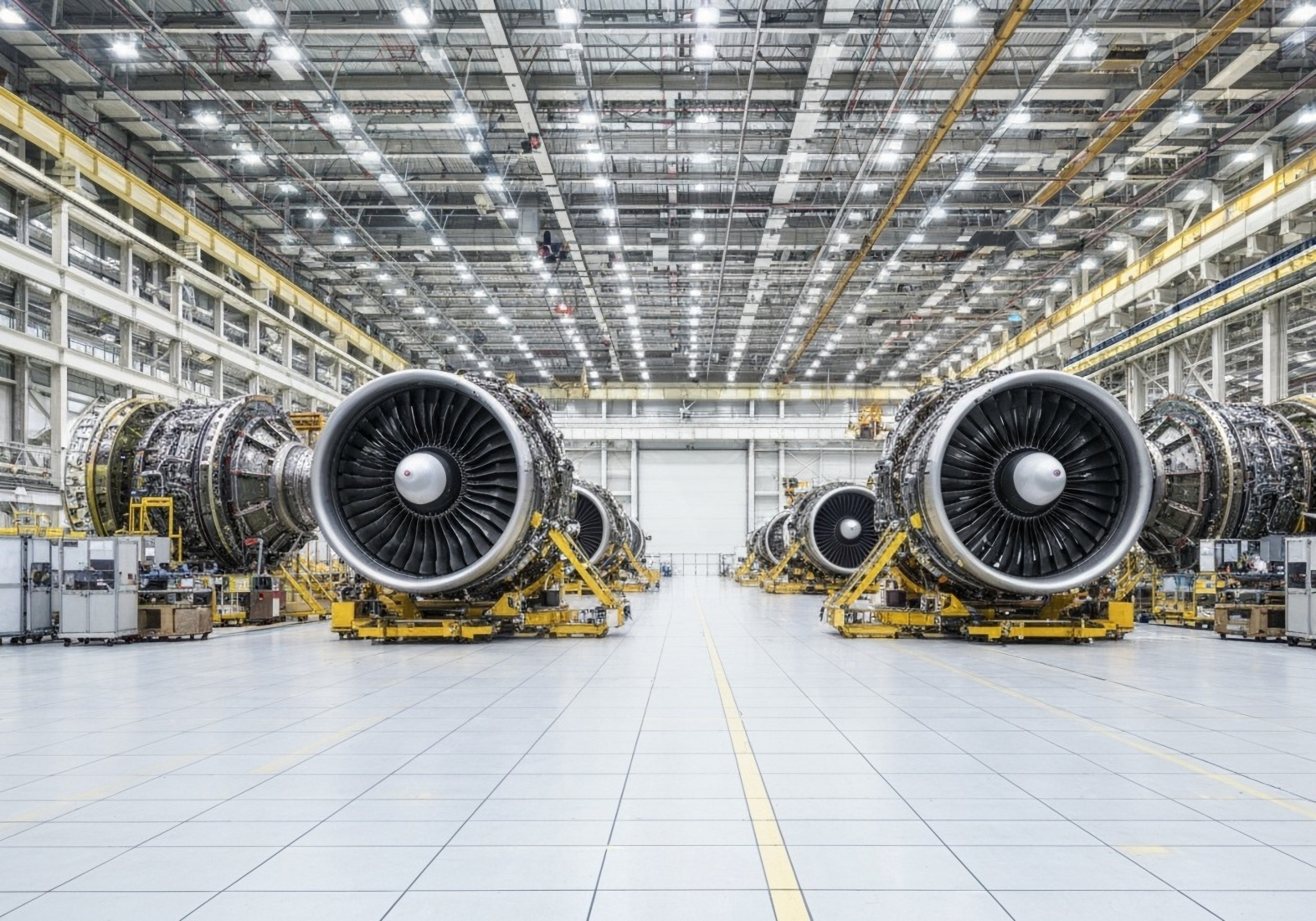
If you drive past a new data-center build in Texas or Virginia today, you might catch a strange sight: a row of trailer-mounted jet engines idling beside concrete shells and cooling towers. They’re not there to fly—they’re there to think.
These machines once powered Boeing 747s. Now, refitted by companies like ProEnergy, their GE CF6-80C2 cores have been reborn as compact, 48-megawatt gas turbines—each one capable of powering a hyperscale AI facility. It’s an image that could have come straight out of a William Gibson novel: icons of a prior industrial age salvaged from the scrapheap, retrofitted with sensors and software mods, and repurposed as power plants for frontier AIs.
For decades, gas turbines were a symbol of decline. Renewables were ascendant, climate pledges were tightening, and the great manufacturers—GE Vernova, Mitsubishi Heavy Industries, Siemens Energy—were shrinking their divisions. In 2017 Siemens announced nearly 7,000 job cuts, warning of “disruption of unprecedented scope and speed.” Demand for large turbines had collapsed from 400 units a year to barely a hundred.
Yet suddenly, they’re back. The reason isn’t geopolitics or industrial policy—it’s artificial intelligence.
Power Is the New Bottleneck
The explosion of generative AI has transformed the economics of power. Every new data-center campus is a micro-city of computation, each building drawing hundreds of megawatts to train and run models that consume orders of magnitude more electricity than traditional cloud workloads. Utilities from Georgia to Dublin are warning of shortages. The bottleneck in the AI boom is no longer GPUs; it’s gigawatts.
Sam Altman put it succinctly in a recent blog post: “Our vision is simple: we want to create a factory that can produce a gigawatt of new AI infrastructure every week… it will require innovation at every level of the stack, from chips to power to building to robotics.”
That phrase—a gigawatt a week—reframes how we think about compute. For the first time in history, intelligence is scaling like heavy industry. The product isn’t just code; it’s capacity. And energy is now the fundamental input to cognition.
What’s happening beneath the surface is a brutal equivalence between computation and energy. To generate intelligence at scale, we will need to convert ever more power into cognition. Jensen Huang of NVIDIA calls this the “token generation rate per unit of energy.” The efficiency of an AI factory, in other words, can be measured not just in flops or model size, but in how many tokens of useful thought it can produce per megawatt.
That equation changes everything. It ties the fate of the digital economy to the physical grid. It means the next generation of leaders in technology, policy, and finance will need to think like energy strategists.
Thought Thermodynamics
The convergence between compute and energy isn’t just a matter of supply and demand. Something deeper is at play. Every leap in intelligence, human or artificial, is powered by a transformation of energy. The steam engine amplified muscle; electricity amplified industry; computation now amplifies thought. Each wave of progress turns energy into a new form of leverage.
The AI revolution is simply the latest expression of that principle. Training models like GPT-5 or Gemini 2 isn’t an abstract digital process; it’s a physical one, requiring power, cooling, materials, and space. Behind every query sits a chain of turbines, transformers, and transmission lines converting natural resources into cognition.
This is what Altman’s vision captures so well. The AI factory is not a metaphor at all—it’s literal. It’s an industrial stack running from chip fabs to power plants, from robotic assembly to energy markets. And like the steel mills and assembly lines of a century ago, it will define a new geography of productivity and a new class of strategic assets.
As nations race to build sovereign AI capacity, the question of where intelligence lives is becoming inseparable from where energy is available. Data-center clusters are springing up near hydro dams, nuclear plants, and gas hubs. Energy policy is becoming industrial policy for the cognitive age.
There is a certain irony in fossil-fuel machinery powering the most advanced software humanity has ever built. I’d love to see one in person. I can just imagine it: turbines spining beneath sodium lights on the edge of the desert, exhaling heat and noise into the night—half relic, half prophecy.
Jet engines are not the end of the story, they are just a cyberpunk patch - a temporary bridge between the industrial and cognitive eras. The real challenge for leaders is not just developing smarter algorithms, but aligning intelligence with the infrastructure that powers it. In the years ahead, energy strategy will become AI strategy. The organizations that understand that connection first will shape the next economy.
